
Puerto Rico offers the lowest effective corporate income tax for those looking to protect their assets and maintain financial privacy. Puerto Rico provides unparalleled value that no other location can match . It is a United States community with a foreign tax structure. Here you can enjoy the benefits and protections of operating within a U.S. jurisdiction with the added tax benefits of operating under a Controlled Foreign Corporation (CFC) structure. Profits from sales to the US mainland are free from U.S. taxation and goods enter the U.S. market duty-free. In addition, Puerto Rico offers a highly attractive incentives package that includes 100% exemption from multiple taxes; special treatment for pioneer industries and much more.
How Can I Help You Today? Both Spanish and English are widely spoken in Puerto Rico.
With a 7% maximum tax rate, tax deductions and exemptions, cash grants, and a financial environment with scores of financing options, Puerto Rico eases the financial burden of your company, making it the perfect place for profits and growth. The government of the Commonwealth of Puerto Rico is committed to supporting this pro-business view by offering a wealth of incentives and favorable tax laws combined with cash grants, tax credits, and venture capital initiatives, further enhancing your bottom line.
Maximize your profits with these and other incentives:
– 7% maximum corporate income tax rate with some qualified companies paying as little as 2 %.
– 2-0 % special corporate tax rate for “Pioneer Industries”
– A 200 % super-deduction for research and development and job training costs.
– Accelerated depreciation for investment in buildings, machinery and equipment with unlimited loss carry forwards.
– 100 % deduction on real and personal property taxes during initial construction and first-year of operations.
– The opportunity to conduct business in the most comprehensive, noncontiguous Foreign Trade Zone system in the U.S.

Tax Rates
The Tax Incentives Act establishes a maximum corporate income tax rate of 7% on the industrial development income. The industrial development income is the income generated by the exempted business.
Specifically, the apparel, textile, shoe, leather products and fish canning industries are eligible for a special tax exemption rate of 4%. In exceptional cases, according to the importance of the investment project the rate could be lowered to a minimum of 2%.
Certain industrial projects that are considered as core pioneer industrial activities by PRIDCO could be eligible for a corporate income tax rate ranging from 2% to 0%. Core pioneer industries are those that employ innovative technology never used in Puerto Rico before January 1, 2000.
Core Pioneer Industries
Operations that are deemed to have a novel or innovative technology not utilized in Puerto Rico before January 1, 2000, and that will have a significant impact on the economic and industrial development of Puerto Rico may qualify for income tax rates between 2% and 0%. Eligibility will depend on such factors as:
– The nature of the employment to be created
– Development of high levels of technical, scientific and managerial expertise in the employees
– The investment to be made in plant, machinery and equipment
– A substantial concentration of production for global markets to be located in Puerto Rico
– The integration of research, development and technological improvements as part of the industrial operation
– Additional tax impact including such factors as payment of withholding tax on royalty payments for technologies transferred

Many Companies, such as Bristol Myers Squibb (Pharmaceutical Company) are taking advantage of Puerto Rico’s atractive tax incentives.
Corporate Income Tax Incentives
There are many tax incentives offered to corporations under the Tax Incentives Act of 1998 and its corresponding amendments. Companies identified as “eligible businesses” qualify for a low corporate tax rate with additional tax credits, exemptions and special deductions. Depending on location, companies may benefit from income, and property tax reductions for periods of 10, 15, 20, and up to 25 years (See map.) The law provides the option to choose the specific years to be covered by the decree. The tax exemption period goes from 10 to 15 years according to business location.
Deductions
1. Payroll – 15% of annual production payroll, or $100,000 deduction
Eligible manufacturing industries may qualify for one of the following alternatives:
(i) a deduction of 15% of annual production payroll up to 50% of industrial development income when the latter is under $30,000 per production worker; or
(ii) a deduction of the first $100,000 of the industrial development income, if it is under $500,000 and the company keeps an average of 15 or more employees.
Tax Incentives Act, section 4(a)
2. Training – 200% tax deduction on training expenses
The Tax Incentives Act offers an additional 100% tax deduction on training expenses related to the exempt business. This special deduction covers training aimed at improving productivity, quality control, and other qualitative aspects included in the human resource sector. This will actually result in a double deduction since it applies in addition to the standard deduction.
Tax Incentives Act, section 4(b)
3. R&D – 200% tax deduction for R&D expenses
Another deduction is granted for research and development expenses for new or improved products or industrial processes. This deduction will not apply to any cash amount received as a donation, subsidy or incentive from the Commonwealth of Puerto Rico for the same purposes. It will also exclude any investment in property or machinery and equipment for which the exempt company had already received a 100% deduction under the deduction explained below.
4. Buildings, Machinery & Equipment – Accelerated depreciation
Every exempt business will be eligible to deduct, in a selected year, the expenditures incurred in the purchase, acquisition or construction of a building, structure, or machinery and equipment as long as these expenditures have not been subjected to prior depreciation and are used to produce the articles or services for which the Commonwealth of Puerto Rico has allowed tax exemptions under this Tax Incentives Act.
Credits
1. Locally Manufactured Goods – 25% tax credit
The Tax Incentives Act provides a credit of 25% for the purchase of products manufactured by unrelated parties in Puerto Rico. Since this credit is created to stimulate the demand for local products it will be allowed only for the amount exceeding the company’s mean purchase of local products for the previous three years. This credit may be applied to the basic income tax liability, but only up to a maximum of a 25% of the taxable industrial development income of the exempt business. This credit may be carried over to subsequent taxable years, until it is exhausted.
2. Locally Recycled Products – 35% tax credit
Exempt businesses that purchase locally recycled products or products manufactured with locally recycled materials will receive a 35% tax credit for the total purchases of said products during the taxable year for which the credit is claimed. This credit may be carried over to subsequent taxable years, until it is exhausted.
3. High Technology Goods: Tax credit for withheld royalty payments
Exempt businesses that produce high technology products, introduced to the market after January 1, 2000 may request from the Secretary of State a credit of the amount exceeding $100 million of annual taxes retained for the payment of rights, rents, royalties and licenses related to the production of those goods. This credit will apply to taxes imposed only to the high tech goods produced by the exempt activity.
4. Purchase of Closing Businesses – 50% credit
Investors who acquire an exempt business that is in the process of closing operations will be eligible to claim a credit of 50% of the cash amount used for the purchase of the corresponding stocks or operating assets of the firm that is going out of business.
5. Stock Owned by Residents of Puerto Rico – 30% credit
Residents of Puerto Rico that own stock in an exempt business will be able to credit 30% of the corresponding income tax paid by the exempted business against any personal income tax obligation due to the Puerto Rico Treasury Department.
Dividend Distribution
Stockholders or partners of a corporation or society that is an exempt corporation that operates under a decree under this Law is not subject to filing income tax returns on dividend distribution or benefits on the industrial development income of the exempt business.

Incentives for Service Industries
Operations of designated services for external markets will also be eligible for a tax rate of 7% on their industrial development income, 90% of their property taxes and 60% on municipal license taxes and fees.
Also, call centers for external markets will be exempted from paying excise taxes on purchases of the equipment needed for their operations.
Industrial Tax Exemption Zones
Depending on your location and industry, your business may receive specific tax exemptions for up to 25 years. Click here or on the thumbnail to see the Industrial Tax Exemption Zone Map.
The Controlled Foreign Corporation (CFC) Investment Model
There’s more than one way to look at your operations in Puerto Rico. The CFC investment model is one that offers particular benefits and higher returns to both U.S. companies establishing CFCs and previously existing CFCs. There are three different models that you can follow, to maximize the advantages offered by Puerto Rico’s tax benefits.

Puerto Rican Business Leaders
Sample Model:
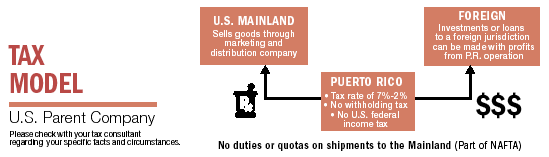
U.S. Parent Company Investment Model
Recommended Tax Structures
Many companies have established their operations in Puerto Rico as profit centers to take advantage of special tax provisions. The goal is to allocate the maximum share of the revenue stream to the lowest tax jurisdiction in which the company can perform their functions effectively, thereby reducing worldwide taxation and enhancing profitability. It is recommended that companies transfer their intellectual property to the Puerto Rico facility (generally through a royalty agreement, but possibly as an outright purchase), and have the Puerto Rico facility assume the operational risks of inventory obsolescence because the control of these rights and risks is part of what determines the revenue split between headquarters, marketing, R&D, and manufacturing.
U.S. Parent
Under the Controlled Foreign Corporation (“CFC”) structure, the Puerto Rico subsidiary, which will generate a maximum corporate income tax rate of 7% with no withholding tax, may use these profits to fund their foreign operations (including the Puerto Rico operations). In order to avoid or postpone repatriation, the Puerto Rico operation can either invest or make loans to other subsidiaries of the parent company from Puerto Rico. Although the earnings of those investments or loans will be taxed as current income by the U.S. federal tax authorities (“Subpart F Income”), the principal will not be taxed until it is repatriated. However, when the funds are repatriated, the company will receive a foreign tax credit for the taxes paid in Puerto Rico.
Another alternative for the use of these funds is to invest in the company’s R&D. The company can perform the R&D in the U.S. mainland or anywhere else; but it is the Puerto Rico operation, which owns and funds the R&D. By investing from Puerto Rico the company will be generating its future tax stream at the lowest tax jurisdiction, i.e. Puerto Rico.
European Union Parent
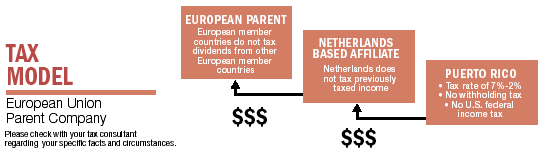
Under the European parent model, the European Union (“EU”) parent has an affiliate in the Netherlands who in turn owns the Puerto Rico corporation. The profits generated by the Puerto Rico operation can be transferred tax free to the Netherlands based affiliate, since the Netherlands does not tax previously taxed income. Furthermore, the Netherlands based affiliate can dividend the profits anywhere in the EU without being further taxed, because the EU member countries do not tax dividends from other EU member countries. The net result is a total tax payment of 7% or less.
Other Non U.S. Parent
Non-US firms can generally benefit even more than domestic firms, as there are more tax-advantaged structures through which to retain profits even after repatriation from the Puerto Rico operation.
More Tax Incentives
Credits:
Credit for purchases of locally manufactured goods
Stockholder tax credit of 30% of the tax paid by the exempt business commensurate to its participation in the ownership of the exempt business.
4% one-time tax on capital gains derived from sales of stock of exempted businesses.
Credit of 50% of the investment in the a acquisition of an exempt business in the process of closing operations in Puerto Rico
Special Deductions:
Deduction of 15% of production payroll to manufacturers whose industrial development income is less than $30,000 per production employee.
A super-deduction of up to 200% for the cost of employee training and R&D expenses
Foreign Trade Zone Advantages:
Puerto Rico has the most comprehensive, non-contiguous Free Trade Zone system in the USA. The system will allow companies to obtain significant financial savings opportunities, since raw material, components, finished goods and packaging may be stored in and transported tax free through these zones. Items shipped abroad after processing are exempt from taxes.
Benefits of the FTZ in Puerto Rico include:
Deferred US customs duties
No US custom duties and Puerto Rico excise tax payments on products exported to foreign markets

Puerto Rico enjoys a well-educated hard-working workforce and low labor costs.
Financing Options:
The public and private sectors in Puerto Rico have joined forces to make locating or expanding your business in Puerto Rico financially attractive. Private and government banks provide long-term or low-interest loans for new businesses locating here. In addition, financing is available from a variety of sources.
Take a look at the following alternatives:
– The Government Development Bank of Puerto Rico (GDB) makes long-term and large loans to the private sector.
– The Puerto Rico Economic Development Bank loans or guarantees loans up to $1.5 million and also invests in qualified high-risk projects.
– AFICA sells Puerto Rico tax-exempt industrial development bonds to provide low-cost financing to some projects.
– The Special Fund for Economic Development provides for economic development in specific scientific and technical research, risk sharing programs for new small businesses and managing tax-exempt businesses.
– Venture Capital initiatives promote venture capital financing for growing companies.
Call or complete our online inquiry form for more information.