Types of Danish Companies / Denmark Companies
In Denmark, there are primarily two forms of companies with limited liability:
Private limited companies (in Danish “Anpartsselskab”).
Public limited companies (in Danish “Aktieselskab”).
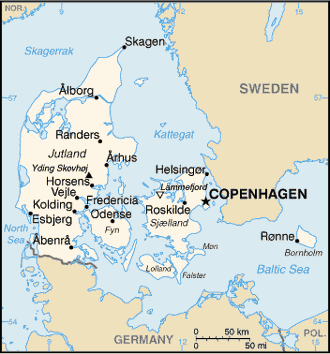
Denmark is a peninsula located just north of Germany. Denmark is bordered by the North Sea and Baltic Sea in Northern Europe. Sjaelland and Fyn are two of its major islands. The capital city is Copenhagen.
Danish Private Limited Companies
The minimum capital requirement for a private limited company is DKK 125,000 equivalent to approx. USD 20,000. This means that the minimum required amount must be deposited into a bank account that has been set aside for the company.
Private limited companies are typically used as holding companies or in connection with the operation of small-sized companies.
It is not a requirement that a private limited company has a board of directors, however, in such case the company must have at least 1 managing director.
Public limited companies and private limited companies are basically governed by the same rules and regulations.
Danish Public Limited Companies
The minimum capital requirement for a public limited company is DKK 500,000 equivalent to approx. USD 80,000. This means that minimum required amount must be deposited into a bank account that has been set aside for the company.
Companies of a reasonable size are normally run as public limited companies.
The board of directors of a public limited company must be comprised by at least three members.
Speed of Registration:
We are linked to the Danish Commerce and Companies Agency. The Agency is the national authority who solely handles the registration of public and private limited companies – from birth to death.
Consequently, we are able to make day-by-day registrations of companies, however, provided that we are in possession of the signed formation documents as well as documentation that the share capital has been transferred as required by Denmark corporation law.
On request, we are able (on our own) to found companies to be resold, referred to as “shelf companies” or “aged companies.”
Before transferring a shelf company we need to receive information regarding the new directors and management, including the necessary personal data.
Denmark Background
Denmark was once the home of Vikings who raided foreign lands. Later it became a major power in northern Europe. Denmark is a modern, affluent nation that is a part of the financial integration of Europe, joining the EEC, now the EU in 1973.
Denmark is almost twice the size of Massachusetts, is bordered to Germany to the south and has a temperate, humid an overcast climate with moderate, windy winters and cool summers.
The country features technologically advanced agriculture, modern small-sized and larger corporate businesses, a large government welfare system, respectable standard of living, and a stable currency. It is very dependant on foreign trade. The nation exports food and energy and is on the positive side of the import/export balance.
The largest exports are machinery and instruments, meat and meat products, dairy products, fish, chemicals, furniture, ships and windmills. Major imports include machinery and equipment, raw materials and semi-manufactures for industry, chemicals, grain and foodstuffs as well as consumer goods.
Denmark has a h2 and growing economy. The government has succeeded in meeting, and even surpassing, the economic convergence conditions for participating in the third phase (a common European currency) of the European Economic and Monetary Union. The country has a high gross domestic product per capita, welfare benefits, stable government and a standard of living enjoyed by few other countries.
To establish a corporation in Denmark, please click here.